

Signing a lease in Dubai feels straightforward until a small error in the paperwork delays your registration. Knowing what to review in a Unified Ejari contract before you sign can save you time, money, and stress. This guide walks through each section of the Unified Ejari contract, explains what every field means, and gives you a practical way to double-check everything.
What Should You Check in a Unified Tenancy Contract?
Every Dubai tenancy contract registered through Ejari should be prepared on the official Dubai Land Department unified template. It is the standard lease format accepted for registration, and the original signed copy is one of the attachments required when you submit. The contract captures the parties, the property details, the contract period, the annual rent, the security deposit, and the payment arrangement.
Before signing, read each section slowly rather than relying on the agent or landlord to fill it in correctly.
Which Property, Tenant, Rent, and Contract Fields Appear on the Unified Ejari Form?
The Ejari tenancy contract fields can be grouped into four areas: property information, party details, rent and payment, and contract terms. Reviewing each group separately makes it easier to spot mistakes. Treat the Unified Ejari contract as a set of connected facts, where the property details must match the title deed, the names must match identification, and the figures must match what you agreed in discussions.
Property Information Fields
This section links your tenancy to the correct unit. The official form includes fields such as:
- Plot number
- Property number
- Location
- Premises number issued by DEWA
- Property type
- Property area in square meters
- Property usage, shown as industrial, commercial, or residential
These details are critical. A single wrong digit in the Unified Ejari contract, especially in the DEWA premises number or plot number, can cause rejections and delay your utility connection.
Tenant and Landlord Details
Both parties should be identified clearly and consistently. Check that:
- Full names match the passport or Emirates ID exactly
- Emirates ID numbers are correct
- Phone numbers and email addresses are valid, since the parties confirm these details as correct for official communication
- A trade license number is included if the tenant or landlord is a company
- The landlord is the registered owner or a properly authorized representative
Rent and Payment Fields
This is the part most people focus on, and rightly so.
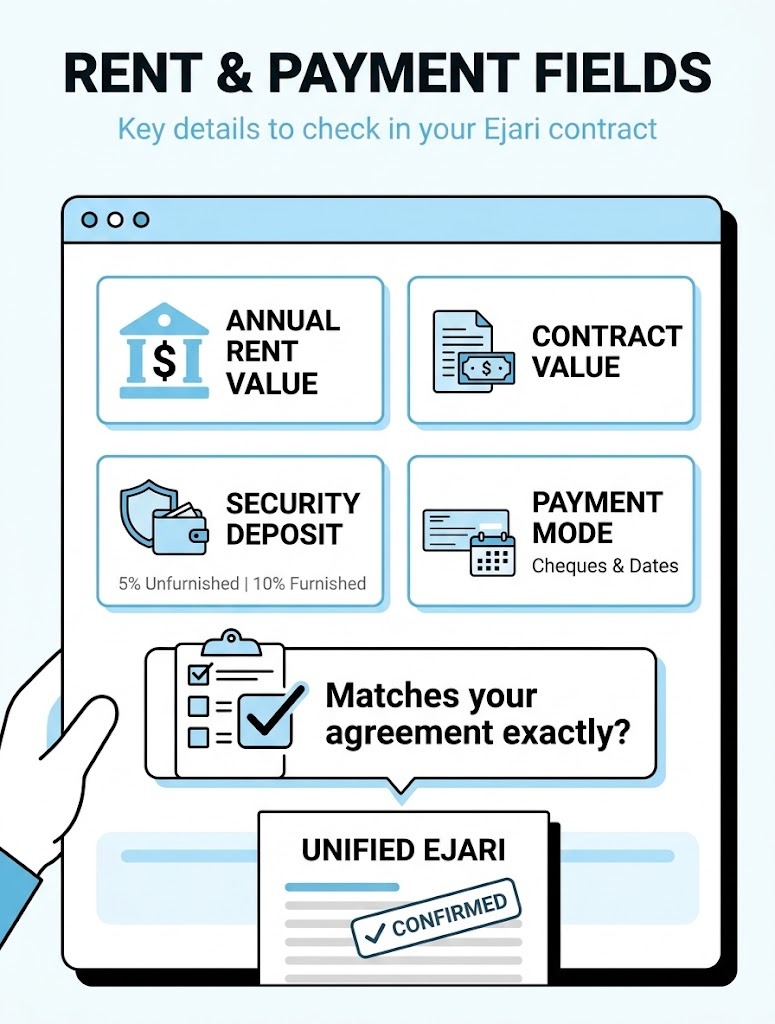
The form includes:
- Annual rent
- Contract value
- Security deposit amount
- Mode of payment and number of cheques
Market practice for deposits is commonly around 5 percent of annual rent for unfurnished units and 10 percent for furnished ones, though this is agreed between the parties and is not a fixed rule. Confirm that the figures in the Unified Ejari contract match your agreement exactly, including the number and dates of payments.
Contract Period and Key Terms
The contract terms section deserves a careful read. Look for:
- Start and end dates of the lease
- Number of co-occupants
- Confirmation that the tenant has inspected the unit and accepted its current condition
- The designated use of the premises
- The rule that subletting or transferring the lease requires written landlord approval
- The landlord undertaking to register the contract with Ejari
- Any addendum for extra terms you have agreed
Rent increases at renewal are also governed by Law No. 43 of 2013, so it helps to understand how that applies before you commit to a long-term arrangement.
A Simple Pre-Signing Review List
Use this Ejari contract checklist before you sign:
- Names match identification documents exactly
- Property numbers match the title deed and DEWA records
- Property usage is marked correctly
- Start and end dates are clear and accurate
- Annual rent and deposit match your agreement
- The payment schedule is written down
- The occupant count is accurate
- Extra agreements are recorded in an addendum
- Both parties have signed in the right places
A short review of the Unified Ejari contract using this list takes only a few minutes and can prevent weeks of correction work.
Documents You Need to Register
The Ejari form requirements typically include:
- The original signed unified tenancy contract
- Tenant Emirates ID
- Landlord passport or Emirates ID copy
- Title deed copy
- DEWA premise number or municipality number
Having these ready alongside a correctly completed Unified Ejari contract helps the registration go through the first time.
Common Mistakes to Avoid
Most delays come from avoidable errors:
- Leaving blank fields for someone to fill in later
- Typing the wrong DEWA premises or plot number
- Using a lease that is not on the official template
- Forgetting to record extra agreements in an addendum
- Ignoring mismatches between the Ejari tenancy contract fields and the title deed
- Overlooking Ejari form requirements until the registration appointment
- Signing a Dubai tenancy contract before checking the deposit and payment terms
Avoiding these mistakes keeps your registration moving and protects you if a dispute ever arises.
Conclusion
A careful review of the Unified Ejari contract protects you from rejected applications, delayed utilities, and avoidable disputes later on. Keep this Ejari contract checklist handy, confirm every number against official documents, and never sign a form with blank fields.
If you would like a second pair of eyes on your paperwork or help with registration, reach out to the team at Ejari Meydan for clear and reliable support.
Frequently Asked Questions
Is the unified template mandatory for registration?
Yes, the official unified tenancy contract is the lease format accepted for registration, so a lease written in another format will usually need to be redone.
Where can I find the DEWA premises number?
It is usually shown on a DEWA bill for the unit, or the landlord can provide it along with the other property documents.
Can we add extra terms to the lease?
Yes, additional terms can be recorded in an addendum that accompanies the contract, as long as both parties agree and sign.
How much is the security deposit?
It is agreed between the landlord and tenant, with market practice commonly around 5 percent of annual rent for unfurnished units and 10 percent for furnished units.
What should I do if I find a mistake after registration?
Contact your landlord and the typing centre or trustee office that handled the registration as soon as possible so the error can be corrected before it causes problems.