

Owning property in Dubai while living abroad is very common, and many owners ask whether they can still register a tenancy contract without being in the country. The short answer is yes. Understanding non-resident Ejari rules helps you avoid delays, rejected applications, and unnecessary travel. This guide explains how access works, which documents are accepted, and how a representative can act on your behalf.
Can a Non-Resident Property Owner Access the Ejari System?
In most cases, yes. Ejari registers tenancy contracts, and the key requirements are proof of ownership and a valid identity, not residency in the UAE. Ejari for non-resident owner cases follows the same basic process as those of resident owners, with differences mainly in the identification documents and in how the owner signs or authorises the registration.
Here is what usually matters:
- You hold a valid title deed or Oqood certificate for the unit.
- The unit exists in the official records and matches your documents.
- Your identity is proven through a passport where an Emirates ID is not available.
- You either act personally or authorise someone to act for you.
When a non-resident Ejari application fails, the cause is usually missing paperwork or a unit that cannot be found in the system, not the fact that the owner lives overseas.
What Documents Can a Non-Resident Owner Use, and Can a Representative Register for Them?
Both questions have practical answers. Owners living abroad typically prepare the following:
- Title deed or Oqood certificate for the unit
- Valid passport copy of the owner
- Signed tenancy contract with rent, duration, and payment terms
- Passport copy and visa or Emirates ID of the tenant
- Power of attorney, if a representative will act
- Recent DEWA bill or premise number, where required
Using a passport is the foundation of Ejari passport registration, since an owner without an Emirates ID can still prove identity through a valid travel document. Documents issued outside the UAE may need attestation or translation before they are accepted. For non-resident Ejari applications, requirements can change, so always confirm the current process with official channels before you begin.
As for the second part of the question, yes, a representative can register for the owner when properly authorised. The details are explained below.
Step-by-Step Guide for Overseas Owners
Follow this sequence to keep things organised:
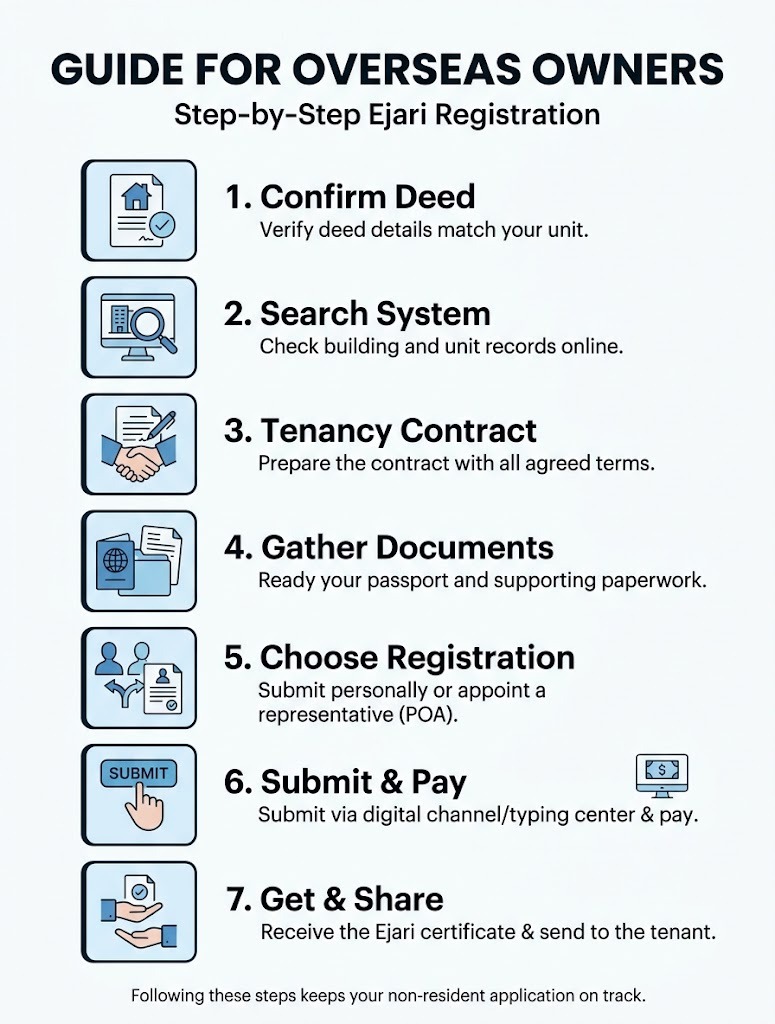
- Confirm that your title deed details match the unit you plan to lease.
- Search the unit in the system to make sure the building and unit are recorded correctly.
- Prepare the tenancy contract with all agreed terms.
- Gather your passport copy and other supporting documents.
- Decide whether you will register personally or appoint an Ejari representative with a valid power of attorney.
- Submit the request through an approved typing centre or official digital channel, then pay the fees.
- Receive the registration certificate and share it with the tenant.
Following these steps keeps a non-resident Ejari application on track and reduces repeat visits.
How an Ejari Representative Can Register on Your Behalf
An Ejari representative is a person you authorise to complete the registration in your place. This can be a family member, a trusted agent, or a property manager. The authority is normally given through a power of attorney that clearly states what the representative may do, such as signing the tenancy contract, paying fees, and collecting the certificate.
Keep these points in mind:
- The power of attorney should be valid and cover tenancy registration.
- Documents signed abroad may need attestation before use in the UAE.
- The representative should carry their own identification as well.
- Choose someone reliable, since they will handle your contract and fees.
This option is especially useful because it removes the need to travel. A well-prepared representative can complete a non-resident Ejari registration in a single visit when the property data is correct.
Why Overseas Owners Often Face Delays
The most common cause of delay for overseas owner Ejari applications is not residency, but data. A unit may not appear in the search because the building is new, the unit number differs from the title deed, or the registry record is incomplete. Communication gaps also play a role, since time zones and attestation requirements can slow down document exchange.
To reduce delays, start early, keep digital copies of every document, and confirm unit details with the developer or owners association before paying any fees. If the unit cannot be found, the registry record must be corrected by an authorised party before the lease can be registered. Repeated searching will not fix missing data.
Common Mistakes to Avoid
- Submitting a power of attorney that does not mention tenancy registration.
- Using documents that have not been attested when attestation is required.
- Searching by the marketing name of the project instead of the registered building name.
- Entering the community name in place of the plot number.
- Paying fees before confirming that the unit can be found.
- Leaving a non-resident Ejari registration until the tenant move-in date is close.
Avoiding these errors can save days of back and forth.
Conclusion
Living abroad does not stop you from leasing your Dubai property. Confirm your ownership documents, prepare a valid passport copy, and decide whether to register personally or through an authorised person. With the right preparation, Ejari for non-resident owner cases become simple, and overseas owner Ejari registrations can be completed without a single flight. Start with a clear checklist, keep your documents consistent, and your tenancy contract will be registered smoothly.
Need expert guidance? Contact the team at Ejari Meydan today. We will review your situation, explain exactly which documents you need, and help you register your lease from anywhere in the world. Speak to the team at Ejari Meydan now and lease with confidence.
Frequently Asked Questions
What is non-resident Ejari?
It refers to registering a tenancy contract for a property owner who does not live in the UAE. The process is similar to standard registration, with identification usually based on a passport and, where needed, a representative acting through a power of attorney.
Can I register my lease without visiting Dubai?
Generally yes. You can appoint an authorised representative with a valid power of attorney, who can sign, pay, and collect the certificate for you.
Is a passport enough as identification?
A valid passport is commonly used when an owner has no Emirates ID. Ejari passport registration still requires proof of ownership, such as the title deed, so prepare both documents together.
Does my power of attorney need to be attested?
Documents signed outside the UAE often need attestation before they are accepted. Confirm the exact requirements with official channels before you submit anything.
What if my unit does not appear in the system?
Recheck the plot number, building name, and unit number against your title deed. If it still does not appear, ask the developer or registered owner to confirm registration and request a correction.