

Providing a home for new hires is common in Dubai, whether you are relocating a senior manager or housing a team. The paperwork, however, is not always simple. Understanding employee accommodation Ejari Dubai rules helps employers keep clear records, avoid disputes, and stay on the right side of housing regulations. Whether you rent a single apartment or arrange company staff housing Dubai-wide for a larger team, the way you document the lease matters. This guide explains who should sign, how to register, and what compliance points to check.
How Should Employers Document Rental Properties Provided to Their Employees?
The most common approach is a corporate lease. The company signs the tenancy contract under its trade licence, the property is registered, and the employee lives in the unit as the occupant. This type of corporate residential lease that UAE employers sign gives the business a clear audit trail and keeps the housing cost in one place.
Alternatively, the employee can sign the lease personally while the company pays the rent or provides an allowance. Each option has different consequences for liability, visas, and what happens when the employee leaves. When you plan employee accommodation Ejari Dubai arrangements, decide the structure first, then document it in writing. A short internal housing policy or an accommodation agreement between the employer and employee helps explain who pays rent, utilities, repairs, and what happens at the end of employment.
Can a Company Lease Multiple Residential Units for Employees?
Yes, a company can generally lease more than one unit, provided each lease is properly signed and registered. Each unit needs its own tenancy contract and registration, and the details must match the property records. For company staff housing in Dubai, employers manage across several units and keep a simple register that lists:
- The address and unit number of each property.
- The lease start and end dates.
- The occupants assigned to each unit.
- The rent amount, deposit, and payment dates.
- The registration certificate and renewal date.
However, there is an important point to watch. Dubai has introduced a shared housing law that regulates properties where several unrelated people each rent their own space. Reports indicate that shared housing can be provided by companies for employees and workers, but only if the accommodation is licensed and meets approved standards. Reports also differ on how labour accommodation is treated. If you plan to place several employees in one residential unit, check whether your arrangement counts as shared housing before you sign.
Who Should Be Named on the Tenancy Agreement?
This is the question that causes the most confusion. There are two usual models:
- Company as tenant: The business is the named tenant, signs through an authorised signatory, and the employee is listed or described as the occupant.
- Employee as tenant: The employee signs the lease, and the company pays the rent or reimburses the cost.
For employee tenancy registration, the company model usually requires a valid trade licence, identification for the authorised signatory, and the landlord documents. The employee model follows the normal personal registration process. Consider the following before you choose:
- Who is legally responsible if rent is unpaid or damage occurs.
- Whether the employee needs the certificate for family visa sponsorship.
- What happens to the lease if the employee resigns or is relocated.
- Whether the landlord accepts a company as a tenant.
Reports note that individual tenancy agreements may not be required where accommodation is provided by the employer to employees in qualifying arrangements, but this depends on how the housing is classified. Confirm your position with the relevant authorities and your legal adviser.
What Compliance Considerations Apply to Employee Accommodation?
Good records and safe housing protect both the business and the staff. For employer-rented accommodation in Dubai, authorities may expect the following; consider these points:
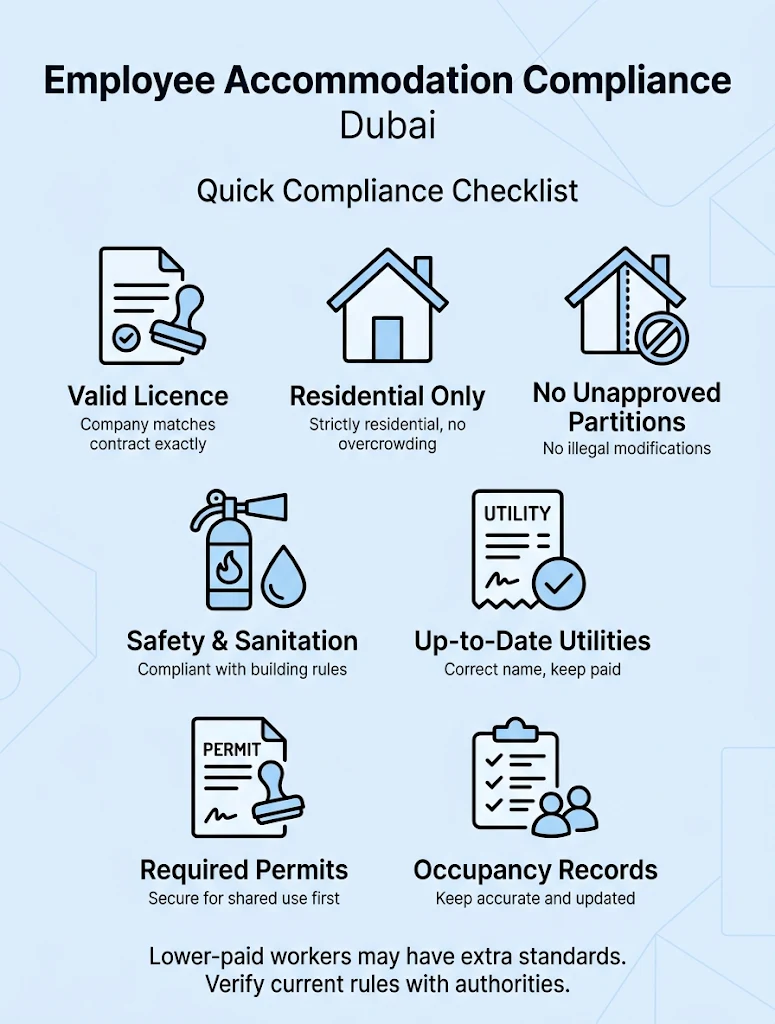
- The trade licence is valid, and the company name matches the contract exactly.
- The unit is used for residential purposes and is not overcrowded.
- The property has no unapproved partitions or modifications.
- Fire safety, ventilation, and sanitation meet the building rules.
- Utilities are registered in the correct name and kept up to date.
- Any permits needed for shared use are obtained before employees move in.
- Records of occupants are accurate and updated when people join or leave.
If the housing is for lower-paid workers, additional labour accommodation standards may apply. Requirements can change, so confirm the current rules with the relevant authorities before you assign people to a property.
Documents Employers Usually Need
Prepare these in advance to avoid delays:
- Valid trade licence and the establishment details.
- Passport and Emirates ID of the authorised signatory.
- Signed tenancy contract with the landlord.
- Landlord title deed and identification documents.
- Employee passport, visa, and Emirates ID details, where required.
- Premises or DEWA number for the unit.
- Power of attorney or authorisation letter, if someone signs for the company.
Step-by-Step Guide to Register
- Decide whether the company or the employee will be the tenant.
- Confirm that the property and unit appear correctly in the property records.
- Check whether your arrangement could fall under shared housing rules.
- Agree on the lease terms and prepare the contract in the approved format.
- Gather the documents listed above.
- Complete the registration through an approved channel and pay the fee.
- Keep the certificate and update your housing register.
Following this order keeps employee tenancy registration smooth and reduces last-minute surprises.
Common Mistakes to Avoid
- Signing the lease in the name of an individual manager instead of the company.
- Letting several employees share a unit without checking the permit rules.
- Failing to renew the registration before the lease expires.
- Moving staff in before the contract is registered.
- Using a company name that differs from the trade licence.
- Ignoring the end of employment, which leaves the lease with no clear owner.
- Skipping a written accommodation policy.
Conclusion
Providing housing is a valuable benefit, but it works best when it is documented properly. Choose the right tenant model, register each unit, and check whether shared housing rules apply to your arrangement. With the right preparation, employee accommodation Ejari Dubai becomes a simple routine, and a well-structured corporate residential lease UAE businesses can rely on protects both the company and its people.
Not sure how to structure your housing arrangement or which documents to prepare? The team at Ejari Meydan is ready to help. We will review your situation, explain what applies to your business, and guide you through the registration. Contact the team at Ejari Meydan today and plan with confidence. This article is general information and not legal advice.
Frequently Asked Questions
Can a company sign a residential lease in its own name
Yes, in most cases, using its valid trade licence and an authorised signatory. Confirm that the landlord accepts a company as a tenant.
Do all employees need to be named on the contract?
Not usually. When the company is the tenant, employees live in the unit as occupants. Keep an internal record of who lives where.
Does the new shared housing law affect staff housing?
It can, if several unrelated employees live in one residential unit. Reports say company accommodation must be licensed and meet approved standards, so check your situation before you proceed.
What happens if an employee leaves the company?
The lease usually stays with the named tenant. Plan whether the unit will be reassigned, handed back, or transferred to the employee.
Is employer-rented accommodation in Dubai treated the same for every business?
No. Rules can differ by the type of housing, number of occupants, and kind of worker. Confirm the current requirements with the relevant authority.