

Understanding tenant rights in Dubai is essential for anyone renting a property in the city. Dubai’s rental system is designed to protect both tenants and landlords, and one of the most important tools in this system is Ejari. Many tenants are unaware of how strongly their rights are protected once their tenancy is registered. Through Ejari registration, rental agreements become legally recognized under the Dubai Land Department, ensuring transparency, accountability, and protection. This guide explains how tenant rights in Dubai are safeguarded through Ejari and what tenants should know in 2026.
As Dubai continues to expand its real estate market with cutting-edge developments, state-of-the-art infrastructure, and a surging influx of global expatriates, the relationship between property owners and occupiers requires strict regulatory oversight. Navigating this vast landscape can be daunting for newcomers and long-term residents alike. Therefore, establishing a foundational understanding of the legal frameworks governing your living or working space is paramount. The government of Dubai has introduced structured electronic systems to eliminate ambiguity, mitigate fraudulent activities, and streamline communication channels between contractual parties.
By standardizing lease agreements through a centralized public utility, the city has successfully cultivated an environment where investments are secure and residential stability is guaranteed for all law-abiding occupants.
What Are the Tenant Rights in Dubai?
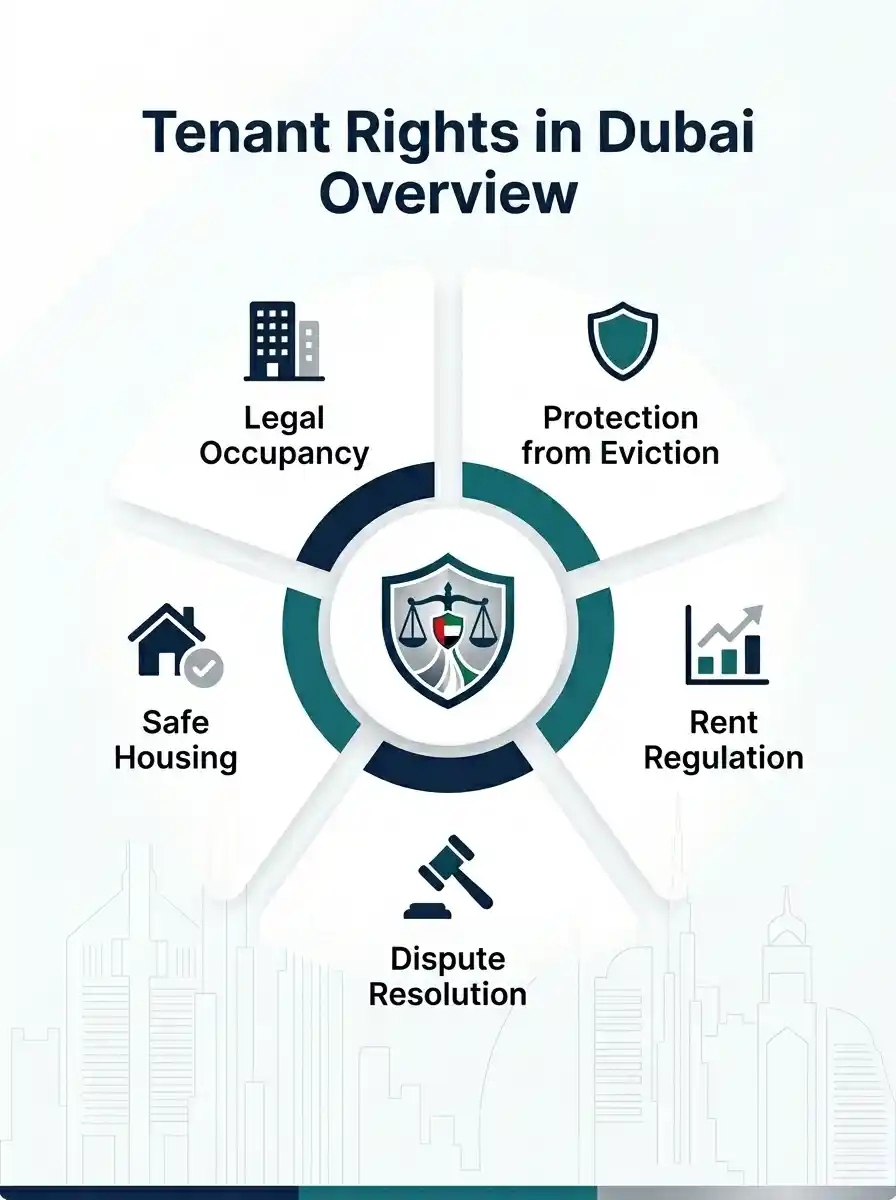
Tenant rights in Dubai refer to the legal protections granted to individuals renting residential or commercial properties in the emirate. These rights are governed by Dubai’s rental laws and regulated by the Real Estate Regulatory Agency (RERA). Once a tenancy is registered through Ejari, tenants gain official recognition under government systems.
The legal structure ensures that tenants are not treated as temporary occupants at the mercy of property owners, but rather as recognized stakeholders with specific entitlements. These regulations are designed to maintain socioeconomic balance, ensuring that rapid market fluctuations do not lead to arbitrary displacement or financial exploitation of residents.
Tenant rights typically include:
- Right to legal occupancy: The assurance that as long as you fulfill your contractual obligations, your right to inhabit the premises is fully protected by state authorities.
- Protection from unlawful eviction: Landlords cannot simply demand that you vacate the premises without following a rigorous, legally mandated administrative procedure.
- Protection against arbitrary rent increases: Financial escalations are strictly controlled by legislative benchmarks rather than personal or market-driven whims.
- Right to dispute resolution: Access to a specialized, objective judicial body capable of arbitrating disagreements impartially.
- Right to safe and habitable housing: The guarantee that the property is maintained in a condition that preserves human health, safety, and operational utility.
These rights become enforceable only when tenant rights in Dubai are backed by an official Ejari registration.
How Ejari Strengthens Tenant Rights in Dubai
Ejari is the foundation of tenant rights in Dubai because it converts private rental agreements into government-recognized contracts. Without Ejari, a tenancy contract is only a private agreement. With Ejari, it becomes legally enforceable.
The word “Ejari” translates to “My Rent” in Arabic, symbolizing a system built to personalize and secure the rental experience for every individual. When a contract remains unregistered, it exists in a legal vacuum where regulatory bodies cannot easily intervene to verify claims, dates, or financial terms. Ejari acts as a protective shield, bridging the gap between private civilian dealings and public institutional enforcement.
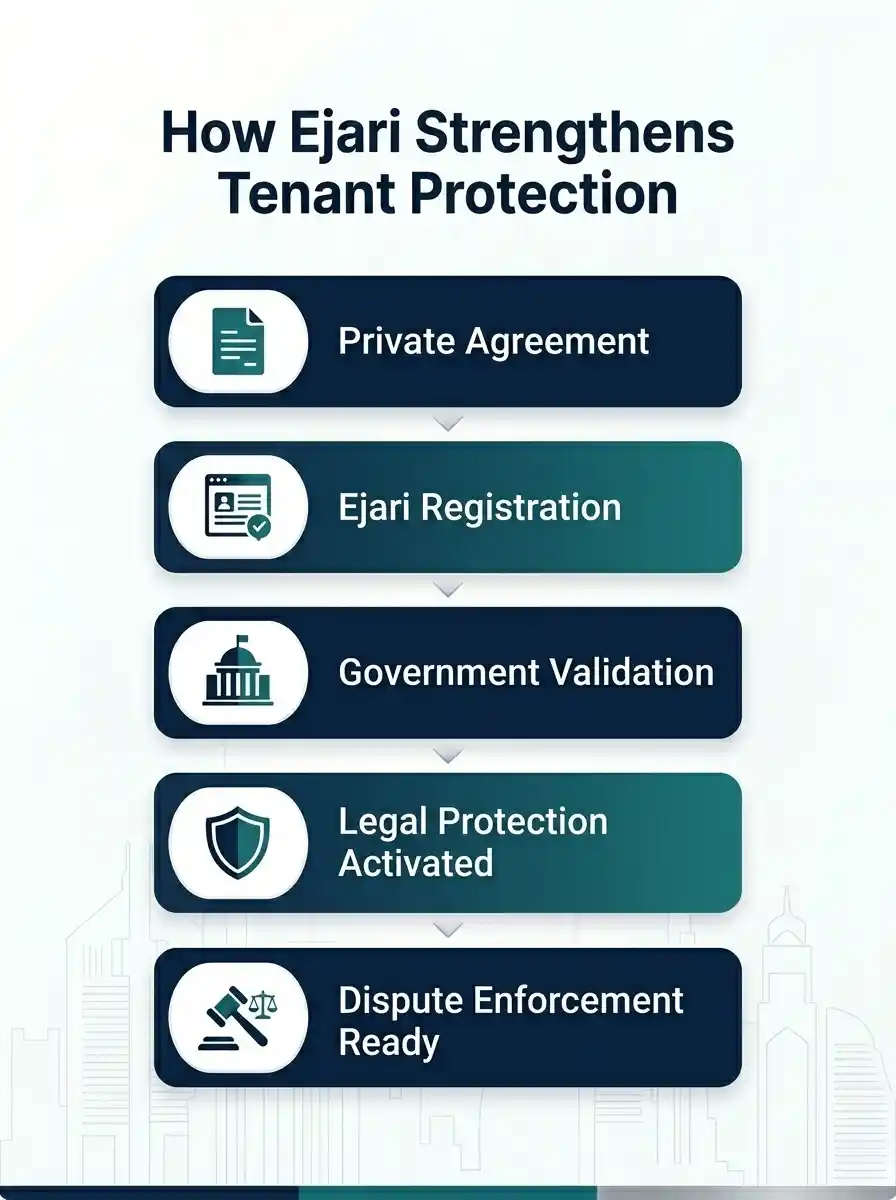
Ejari Provides Legal Protection Through:
- Official government registration: Embedding the lease parameters directly into the central database of the Dubai Land Department (DLD).
- Verified tenancy records: Creating an unalterable, chronological history of the lease that cannot be forged or retroactively manipulated.
- Transparent rental agreements: Eliminating hidden clauses or unwritten expectations by forcing all conditions onto a standardized public template.
- Legal documentation for disputes: Supplying the primary evidence required by judicial authorities to process any formal complaint.
- Structured rental framework: Aligning the lease with the broader macroeconomic guidelines set forth by the Dubai municipality.
This ensures that tenant rights in Dubai are protected at every stage of the rental process.
First-Time Tenant Guide to Ejari Registration
If you are renting a property in Dubai for the first time, the First-Time Tenant Guide to Ejari Registration can help you understand the registration process, required documents, common mistakes, and what to expect after your tenancy is officially registered. Having a clear understanding of Ejari from the beginning can help you protect your tenancy rights, avoid unnecessary delays, and ensure you are prepared for services such as DEWA activation, visa-related applications, and rental dispute resolution.
Can Landlords Increase Rent Anytime in Dubai?
One of the most common concerns related to tenant rights in Dubai is rent increases. Landlords in Dubai cannot increase rent arbitrarily.
The real estate climate in Dubai is highly dynamic, often experiencing rapid shifts in valuation, demand, and occupancy rates. In a completely unregulated environment, such conditions could lead to sudden, unsustainable spikes in living costs for residents. To prevent this volatility from harming the community, the government has instituted clear, arithmetic parameters governing how and when a property owner can modify financial terms.
Rent adjustments must follow:
- Dubai rental index guidelines: A dynamic, public database reflecting real-time average market rates across specific geographic communities.
- RERA regulations: Legally mandated percentage bands that dictate exactly how much rent can rise based on how far below the market index the current lease sits.
- Official notice periods: A strict statutory requirement demanding that landlords notify tenants of any intended changes at least 90 days before the contract expires.
- Market value assessment: Formal evaluations conducted through official valuation certificates if an exceptional disparity is claimed.
Ejari ensures that all tenancy agreements remain properly recorded, which helps regulate rent increases. Without Ejari registration, enforcing tenant rights in Dubai becomes difficult in disputes involving rent changes.
Ejari Legal Protection for Tenants
One of the strongest benefits of Ejari is its legal protection for tenants. Once a contract is registered:
- Rental agreements become legally binding: Elevating the text from a simple piece of paper to an instrument of state law.
- Tenant information is recorded in government systems: Integrating your residency status with municipal utilities, civil records, and identity databases.
- Disputes can be officially filed: Granting you the standing required to approach municipal tribunals for relief.
- Rental terms are enforceable in court: Allowing judges to issue binding directives against non-compliant property owners.
This strengthens tenant rights in Dubai by ensuring fairness in landlord-tenant relationships.
Tenant Rights in Dubai in Rental Disputes
Rental disputes are common in many cities, but Dubai has a structured system to handle them. When communication breaks down between a landlord and an occupant, the issue is referred to the Rental Dispute Center (RDC), the judicial arm of the Dubai Land Department.
The RDC acts as a specialized court designed to resolve housing conflicts swiftly, saving both parties from long, expensive civil litigation. However, this administrative court operates on strict evidentiary rules. They do not rely on verbal promises, informal text messages, or unverified documentation.
Ejari Role in Disputes
Ejari helps by providing:
- Proof of tenancy: Conclusive, state-verified evidence that a lawful landlord-tenant relationship exists.
- Contract duration records: Indisputable proof of the exact start and end dates governing the occupancy.
- Payment terms documentation: Official clarification regarding the agreed-upon annual sum and the frequency of cheque installments.
- Property details verification: Exact identification of the specific unit, building, and plot number under dispute.
This makes dispute resolution faster and more transparent. Without Ejari, enforcing tenant rights in Dubai becomes significantly more difficult.
Why Ejari Registration Is Essential for Tenant Rights in Dubai
Ejari registration is not optional; it is a legal requirement for most tenancy agreements in Dubai. It functions as the definitive gatekeeper for almost every subsequent civil and administrative service you will require while living in the city.
The system was created to eliminate the underground rental market and protect the city’s economic reputation. By making registration mandatory, the government ensures that every transaction is accounted for, creating a safe, highly regulated real estate ecosystem.
Ejari Ensures:
- Legal recognition of tenancy: Validating your presence within the country’s real estate framework.
- Protection against fraud: Preventing malicious actors from renting out properties they do not own or leasing a single unit to multiple unsuspecting parties simultaneously.
- Accurate rental records: Supplying the statistical data needed to keep the RERA Rental Index fair and accurate.
- Government-backed documentation: Delivering a universally accepted certificate bearing unique digital verification codes.
Without registration, these tenant rights are not fully enforceable.
How Tenant Rights Dubai Protect Against Eviction
Eviction laws in Dubai are strict and regulated. A landlord cannot evict a tenant without valid legal reasons. Property owners cannot simply change the locks, cut off utilities, or demand immediate departure because they wish to find a higher-paying occupant.
To initiate an eviction, a landlord must provide a full 12 months’ notice prior to the requested move-out date. Furthermore, this notice cannot be a casual email or conversation; it must be served formally through a notary public or via registered mail to be considered legally valid.
Protected Scenarios Include:
- Contract expiration: Even when a lease ends, it automatically renews under the same terms unless proper legal notice was given 90 days prior.
- Property redevelopment: If the owner wishes to demolish or comprehensively renovate the building, they must prove the work requires the unit to be completely vacant.
- Personal use with legal notice: If the landlord intends to recover the property for their own personal use or for immediate next of kin, backed by proof that they do not own an alternative suitable property.
- Non-payment of rent: Eviction for non-payment requires formal warnings and specific grace periods before any action can be pursued.
Ejari records provide legal evidence that supports tenant rights in Dubai in eviction cases.
Ejari and Transparency in Rental Agreements
Transparency is a key part of tenant rights in Dubai. By eliminating asymmetric information, where one party holds an unfair advantage over the other, Ejari fosters mutual respect and professional behavior in the real estate sector.
When a contract is processed through the Ejari portal, it is automatically checked against the actual deeds of the property stored within the Dubai Land Department systems. This structural cross-referencing protects tenants from entering into fraudulent agreements with individuals who do not possess the legal right to lease the premises.
Ejari ensures:
- Clear contract documentation: Standardizing terms so that hidden costs, unusual maintenance policies, or illegal penalties cannot be surreptitiously introduced.
- Verified landlord identity: Ensuring the individual signing the contract is either the true owner or a legally appointed representative holding a valid power of attorney.
- Accurate property details: Verifying that the physical specifications of the unit match official municipal records.
- Government-level record keeping: Securing your data within a protected state network, immune to loss or unauthorized alteration.
This reduces misunderstandings and protects tenants from unfair practices.
How Ejari Supports Tenant Rights in Utilities
Many tenants do not realize that utility access is linked to Ejari. The modern infrastructure of Dubai relies on integrated systems where one public service communicates directly with another to automate provisioning and maximize efficiency.
When your Ejari certificate is generated, a digital trigger is sent to municipal utility networks. This connection ensures you can set up your home quickly and smoothly, avoiding the need to visit multiple government offices or submit endless physical paperwork.
Ejari Helps With:
- DEWA activation: Enabling instant setup of your electricity and water accounts with the Dubai Electricity and Water Authority.
- Internet setup: Providing telecom companies with the official address verification required to install high-speed home internet and television services.
- Address verification: Supplying a recognized document for corporate HR departments, banking institutions, and vehicle registration processes.
- Residency applications: Serving as the definitive proof of address needed to sponsor family members or domestic staff for residency visas.
Without Ejari registration, essential services may be delayed, affecting Tenant Rights in Dubai indirectly.
Common Violations of Tenant Rights in Dubai
Even with strong regulations, tenants sometimes face issues. Knowing how to identify a violation is the first step toward correcting it. Property owners may sometimes try to exploit a tenant’s lack of legal knowledge to save money or increase their returns.
Common Problems Include:
- Unjustified rent increases: Demanding a higher rate without consulting the RERA calculator or missing the mandatory 90-day notification window.
- Delayed maintenance: Failing to address structural defects, air conditioning failures, or plumbing leaks that compromise the property’s livability.
- Early eviction attempts: Threatening tenants with immediate removal without a formal 12-month notice served through the proper legal channels.
- Contract disputes: Attempting to alter agreed-upon terms, such as changing the number of rent cheques allowed mid-year.
- Hidden charges: Demanding unexpected administrative fees, commission renewals, or inflated community management costs not explicitly stated in the lease.
Common Ejari Rejection Reasons to Avoid
Even when you have all the basic documents ready, an Ejari application can still be rejected because of incorrect tenant information, missing signatures, expired identification documents, mismatched property details, or unclear document scans. Checking these details carefully before submission can prevent unnecessary delays. If your application has been rejected or you want to reduce the risk of rejection, understanding the most common Ejari rejection reasons can help you correct potential problems before submitting your application.
Ejari Legal Protection in Dubai Land Department System
Ejari is fully integrated into Dubai Land Department systems. This deep technical integration ensures that your tenancy data is not just stored in an isolated database, but is linked directly to the city’s broader legal and financial framework.
This shared ecosystem makes it impossible for property owners to bypass rental laws. For instance, if an ongoing rental dispute is logged against a specific property within the DLD system, that status is visible across municipal agencies. This prevents the landlord from selling the property or leasing it to someone else until the conflict is resolved.
This integration ensures:
- Digital record accuracy: Eliminating human error and keeping documents accessible through official government smart applications.
- Legal enforcement capability: Enabling immediate enforcement of court orders or RDC judgments directly against a property file.
- Structured dispute resolution: Streamlining the case submission pipeline by pulling verified contract details automatically into legal filings.
- Verified tenancy contracts: Providing third-party institutions, like banks and courts, with instant proof that your lease is completely authentic.
This integration strengthens the tenant rights in Dubai across all rental transactions.
How Tenants Can Maximize Their Rights
Tenants can strengthen their protection by following best practices. True security in a rental property requires active awareness and careful documentation from the very beginning of the lease.
Recommended Steps:
- Always register Ejari: Do not delay this step; complete the registration immediately upon signing the lease and handing over the initial cheques.
- Keep copies of contracts: Maintain organized digital and physical folders containing all signed addendums, copies of cheques, and written communications.
- Understand rental laws: Dedicate time to studying Law No. 26 of 2007 and its amendments, which govern landlord-tenant relationships in Dubai.
- Verify landlord information: Request a copy of the owner’s passport and the title deed of the property before transferring any funds.
- Renew agreements on time: Initiate renewal conversations at least 90 days before expiration to ensure your terms are locked in properly.
These actions ensure full protection under tenant rights in Dubai.
Why Ejari Meydan Supports Tenant Rights in Dubai
Professional Ejari support helps tenants avoid errors and delays. Navigating government portals, translating legal documents, and ensuring compliance with changing municipal guidelines can be challenging, especially for busy professionals or new residents.
Partnering with an experienced service provider simplifies the process, ensuring your lease is registered correctly the first time. This protects your rights from day one and prevents administrative errors that could leave you vulnerable in a future dispute.
Ejari Meydan assists by:
- Handling registration accurately: Reviewing every line of your tenancy contract to ensure all details are entered into the government database correctly.
- Verifying documents: Checking title deeds, landlord identification, and power of attorney forms to ensure your contract is safe and legally sound.
- Preventing rejection issues: Catching minor formatting errors, missing signatures, or incorrect unit numbers before they cause system delays.
- Ensuring compliance: Confirming your agreement follows the latest RERA guidelines and Dubai Land Department regulations.
- Supporting dispute readiness: Organising your documentation so that you have clean, certified records ready if you ever need to approach the Rental Dispute Center.
This helps tenants fully benefit from their rights’ protection.
Conclusion
Understanding tenant rights in Dubai is essential for every tenant living in the city. Ejari plays a critical role in strengthening these rights by converting private tenancy agreements into legally recognized documents under Dubai law. From rent protection to dispute resolution and eviction safeguards, Ejari ensures transparency and fairness in every rental transaction. By completing Ejari registration and staying informed about rental regulations, tenants can fully protect their rights and enjoy a secure renting experience in Dubai.
FAQs
What are tenant rights in Dubai?
They are legal protections given to tenants under Dubai rental laws, specifically managed by RERA and the Dubai Land Department, to ensure fair treatment regarding occupancy, rent adjustments, maintenance, and evictions.
How does Ejari protect tenant rights?
Ejari registers tenancy contracts officially with the government, making them legally enforceable. This steps your contract up from a private note to an official record that courts and municipal utility companies recognize.
Can landlords increase rent anytime?
No, rent increases must follow RERA guidelines and use the official RERA rental index. Landlords must also give tenants a proper 90-day notice before the contract expires to propose any changes.
Is Ejari required for tenant protection?
Yes, without Ejari, tenancy agreements are not fully enforceable before the Rental Dispute Center, and you will not have access to official state arbitration if a conflict arises.
What happens if Ejari is not registered?
Tenants may face issues with utilities, disputes, and legal protection. You will not be able to activate your DEWA account, set up home internet, sponsor family visas, or file an official complaint against an abusive landlord.